Average Reviews:

(More customer reviews)Are you looking to buy Socrates in Sichuan: Chinese Students Search for Truth, Justice, and the (Chinese) Way? Here is the right place to find the great deals. we can offer discounts of up to 90% on Socrates in Sichuan: Chinese Students Search for Truth, Justice, and the (Chinese) Way. Check out the link below:
>> Click Here to See Compare Prices and Get the Best Offers
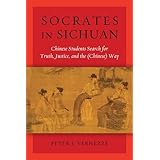
Socrates in Sichuan: Chinese Students Search for Truth, Justice, and the (Chinese) Way ReviewThis is a charming book.Peter Vernezze is another Peace Corps volunteer who, in the Peter Hessler tradition, chronicles his experience teaching college students in Sichuan. (The other great book on China by a former Peace Corps volunteer is Michael Meyers' superb The Last Days of Old Beijing.) Vernezze, who had taught philosophy in the US for 15 years, was an English teacher at Sichuan Normal University, and for two years he held a weekly discussion group on philosophy that grew increasingly popular.
Being neither a "China expert" nor a philosophy expert (one semester in college), I found this book offered both a valuable primer on the influence of Confucius and the Tao, which is going strong to this day, as well as an intriguing glimpse into the mindset on contemporary young Chinese people.
The author starts by describing the typical university classroom: rows of desks bolted to the floor, all facing the front-center of the room from which the professor will lecture them. The room is designed to discourage peer-to-peer discourse, and as Vernezze later explains, peer-to-peer discourse is something the Chinese student absolutely does not desire. They see themselves, he writes, as vessels into which the professor is expected to deliver his knowledge. They aren't interested in what their fellow students have to say. Anything of value will come from the teacher.
So it makes perfect sense that he holds his philosophy discussion group in local coffee shops where students can sit facing one another. There, he challenges them with questions such as What is Truth? What is Sanity? Is life a matter of fate or free will? How Vernezze draws his students out, and the stumbling blocks that challenge him, makes for excellent reading.
The one trend that permeates nearly every chapter (and one that you're probably all at least somewhat familiar with) is the almost reflexive need for his Chinese students to find a "middle way," an answer to his questions that take into account all sides, so the answer they give won't hurt anyone or cause them to lose face, including the teacher. This is the very opposite of the approach of US students, who form strong opinions and argue them with passion. The principle that "there are two sides to every coin" applies to nearly every answer the students offer throughout the book. Life is about finding a middle way, and Vernezze does a masterful job of linking contemporary Chinese attitudes with the teaching of Confucius and the Tao.
He is also very funny. He relates, for example, a discussion on elections he had with his academic superior at Sichuan Normal, who believes, in Vernezze's words, that "the antithesis of harmony is not chaos but rather America."
"I do not understand," he said smiling. "why you Americans put yourselves through this every four years. It seems crazy to us Chinese. Why go through all this fighting and rancor? We had our period of chaos during the Cultural Revolution. No one here wants to go back to that."
"I wasn't sure how many people died in the American electoral process in the past two hundred years, but I was pretty certain it was significantly fewer than the three million some historians estimate perished during the Cultural Revolution Which is not to say that he did not have a point. No one doubts the American political system is broken...."
This wry humor finds its way onto nearly every page. And every exchange he relates takes us deeper into the minds of his students, whether they're discussing the government's suppression of the 2008 riots in Tibet, the attack on the World Trade Center, the Sichuan earthquake or even homosexuality (he is amazed at how tolerant his students are on this issue).
A simple phenomenon, like the Chinese people's attitude toward credit cards, is a source of precious insight. Vernezze notes that in China, your credit card is backed up by cash you pay the bank in advance, so you are never actually borrowing money that isn't yours:
"The very notion of credit cards -- that you would spend money one didn't have -- horrified most of the students. This attitude seemed to me not merely the result of a culture of saving but indicative of a philosophical worldview that is profoundly different than the Western one. I would argue that the very idea of the credit card has a particularly American flavor to it, embodying an attitude of optimism. Since Americans are certain that the future will be better than the present, we feel comfortable spending money we don't have. By contrast, the Chinese idea, which finds its philosophical basis in Taoism, is that because reality is in a constant state of flux -- the young becomes old, hot becomes cold, what is hard is broken down into what is soft -- one should take no course of action that makes overly optimistic assumptions about the future. Say what you will about this attitude, but I can tell you this: no Chinese would have taken out a mortgage that he knew was going to balloon in a few years on the hope that he would be able to refinance at the time based on the value of the house."
The beauty of the book is the interactions with the students themselves (they're too long for me to paraphrase in a way that does them justice). The final pages wrap it all up and help clear up an obvious question the book raises, which is whether the Chinese philosophy of self-interest and materialism leaves the door open for a society without fundamental ethics. He notes (surprisingly, for me) that this philosophy is not much different than the ancient Greeks', and yet there exist in both societies "real ethical standards that can direct human behavior."
"...if the existence of laws in the physical and psychological realms does not require the presence of a spiritual reality, it should come as no surprise that for both the ancient Greeks and modern Chinese, the fact that there is only the natural world does not preclude the presence of a moral law. Indeed, in both traditions ethical laws for regulating human conduct have the same status as laws of of physical and psychological health; they are relevant and sought out by the intelligent person wishing to have a good life."
While I'm quoting a lot about the theory, the actual magic is in the characters who attend the discussion group, how they interact with the teacher and their peers, and how they grapple with logic, the very nature of which goes against how they were taught to learn (rote memorization vs. inquiry and discussion). Often the most fun part is when the students offer responses that are so not what the teacher expected to hear that his own belief systems are challenged, and he is forced to think in a whole new way.
Finally, it's a great bird's eye view into teaching in rural China, many years after Hessler wrote River Town, the gold standard on the subject. Much has changed, while a lot has remained the same.
Again, I'm no philosopher, so I may not be able to engage on the issues I've raised. For a marvelous discussion about it all, get the book.Socrates in Sichuan: Chinese Students Search for Truth, Justice, and the (Chinese) Way OverviewWhen Peter J. Vernezze took a leave of absence from his position as a philosophy professor to serve as a Peace Corps volunteer in China, he supplemented his main task-teaching English-with leading a weekly philosophical discussion group with Chinese undergraduate and graduate students at Sichuan Normal University in Chengdu. In each session the students debated topics as diverse as the status of truth, the meaning of life, the reality of fate, the definition of sanity, the necessity of religion, and the value of romantic love. Each of the twenty-five chapters focuses on the topic of one evening's discussion, which was always in the form of a question: How are ancient conceptions of virtue holding up in a society overrun by capitalism? Are traditionally conservative sexual values going the way of the rickshaw? Can an atheistic country even have a sense of morality?This unprecedented portrait of the Chinese mind allows the up-and-coming generation-known as the ba ling hou, or 'post-1980s generation"-to express its unique perspective on China-and America. In addition, the book provides the reader with a crash course in Chinese culture, both ancient and modern, as students discuss everything from Confucius to the Edison Chen scandal (a Chinese pop star whose sexually explicit pictures found their way onto the Internet), from classical Chinese poetry to the Super Boy and Super Girl competitions (Chinese versions of American Idol).Throughout, the author provides the intellectual and historical context necessary to appreciate and understand today's China.
Want to learn more information about Socrates in Sichuan: Chinese Students Search for Truth, Justice, and the (Chinese) Way?
>> Click Here to See All Customer Reviews & Ratings Now

0 comments:
Post a Comment