Average Reviews:

(More customer reviews)Are you looking to buy A Student's Guide to Maxwell's Equations? Here is the right place to find the great deals. we can offer discounts of up to 90% on A Student's Guide to Maxwell's Equations. Check out the link below:
>> Click Here to See Compare Prices and Get the Best Offers
A Student's Guide to Maxwell's Equations ReviewThis is the best overview of Maxwell's equations I have ever come across. I cannot praise it enough for it's brilliant clarity.If you have taken or are taking an electromagnetism or vector calculus course, you may have run into the classic problem of not being able to see the forest through the trees. These courses can be very dense, and anything that can help give a sense of perspective can be very helpful. Daniel Fleisch's book is just such a tool. It provides a thorough overview of Maxwell's equations with stunning clarity. Each equation is broken down into it's component parts, and the physical significance of each part is thoroughly explained. In this way, not only are the core concepts of Maxwell's equations made clear, but many concepts from vector calculus are also brought out in crystal clarity, (I got much more out of this book than I did the often recommended "Div, Grad, Curl"). It will help you see the "forest through the trees".
Also of note are the problem sets at the end of each chapter. The problems work very well to reinforce the concepts from each chapter. They are not overly difficult or too simplistic. They are geared specifically at reinforcing concepts. The author has also posted on his web site a set of solutions for every problem, and each of the problems is thoroughly worked out with clear explanations. This is a HUGE plus for anyone picking up this book for self-study.
In my mind this book is a perfect compliment to an electromagnetism or a vector calculus class (or as a review after having taken such a class). Although the writing is clear enough that one could probably get a lot even without having had a vector calculus class, ideally one would have had at least some minimal exposure to vector calculus. It's not that you need to be an expert in vector calculus; all the concepts are explained very well in the book and the actual calculus you need for solving the problems is minimal, but in my mind the book will work best for those with some exposure to vector calculus.
My only suggestion to the author would be to include a table summarizing Maxwell's equations, (and perhaps a table of some basic constants). Other than that, this is a perfect book. It is THE standard by which other self-study books ought to be compared.
Update: When I wrote the above review I was half way through chapter 4 (of five chapters). Having completed the book, I do want to point out that the beginning of chapter 5 ('From Maxwell's Equations to the Wave Equation) does include a summary of Maxwell's equations. It would have been nice to have such a table at the front or back of the book for quick reference, but the summary is there, contrary to what I had originally thought. Chapter five also has a nice summary of the del operator and its use in finding the gradient, divergence, and curl. And finally, chapter five provides a very good physical description of the Divergence Theorem and Stokes' Theorem. So all in all, there is really little one can fault in this book. It's the book to get if you want to see the forest through the trees.[Side note to author (written before the above update, and answered by the author in the comments): I believe the solution to problem 2.3 for surfaces 'A' and 'B' should include a factor of 1/2 since the area is a triangle; I did not see a feedback form on the website, or I would have posted there.]
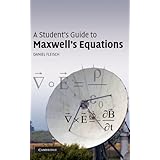
A Student's Guide to Maxwell's Equations OverviewGauss's law for electric fields, Gauss's law for magnetic fields, Faraday's law, and the Ampere-Maxwell law are four of the most influential equations in science. In this guide for students, each equation is the subject of an entire chapter, with detailed, plain-language explanations of the physical meaning of each symbol in the equation, for both the integral and differential forms. The final chapter shows how Maxwell's equations may be combined to produce the wave equation, the basis for the electromagnetic theory of light. This book is a wonderful resource for undergraduate and graduate courses in electromagnetism and electromagnetics. A website hosted by the author at www.cambridge.org/9780521701471 contains interactive solutions to every problem in the text as well as audio podcasts to walk students through each chapter.
Want to learn more information about A Student's Guide to Maxwell's Equations?
>> Click Here to See All Customer Reviews & Ratings Now


